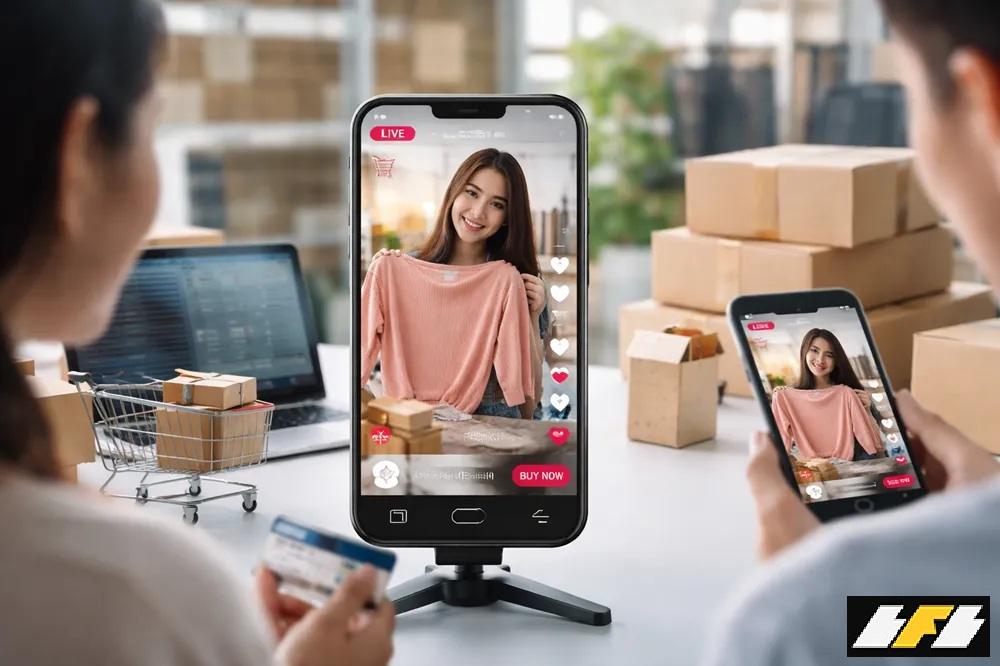

For a long time, the e-commerce purchase journey was treated as a relatively organized path: discovery, consideration, conversion . Each step in its place, with defined channels, clear metrics, and well-distributed responsibilities.
Live commerce fits into this model not to replace this logic, but to “mess it up” a bit (in a good way). It doesn’t respect such rigid boundaries. And perhaps that’s precisely where its greatest value lies.
Unlike other formats, live commerce doesn’t fit comfortably into a single stage of the customer journey . It spans distinct moments in the decision-making process and, for that very reason, is often analyzed in a limited way when the only criterion is immediate conversion .
The numbers show that the channel is no longer experimental. A survey by CNDL indicates that 31% of Brazilian consumers say they have already used live commerce as a shopping channel .
Meanwhile, the Brazilian live commerce market generated US$151.2 million in 2024 and is expected to reach US$488.3 million by 2030 , with an average annual growth of 21.9%, according to Grand View Horizon.
But what exactly does live commerce do within the buyer’s journey?
Live commerce is not just transforming how we communicate and sell, it’s redefining how we operate.
By transferring the purchase decision to a live, simultaneous, and highly responsive environment, it drastically shortens the interval between desire, confirmation, and delivery expectation.
This compression of time changes the role of logistics within e-commerce: from a structure prepared for continuous flow to an operation capable of responding to concentrated demand events.

Logistics as an extension of experience
Unlike traditional digital campaigns, where orders are spread over hours or days, live commerce generates waves of consumption that are almost instantaneous.
The audience watches together, decides together, and buys together. This creates more intense and less predictable operational peaks, requiring process flexibility, rapid resource mobilization, and the ability to scale order preparation without compromising accuracy or deadlines.
For those who grew up watching, buying live is natural.
This behavior becomes even more evident when we look at younger generations. According to EAE Business School, 71% of Generation Z spends about three hours a day consuming videos on platforms such as TikTok, YouTube, Twitch, and Instagram Reels .
For this audience, watching someone present, test, or comment on a product live is nothing new, but rather a native language .
It’s also important to keep in mind that the live commerce experience doesn’t end when the broadcast is over.
In fact, it is at this moment that logistics becomes the silent protagonist of the journey. The expectation created during the live event is immediate: the consumer does not perceive their purchase as part of a conventional flow, but as the result of an event to which they responded emotionally.
Any misalignment between what was promised live and what is delivered afterward (be it delays, unavailability, or communication failures) directly undermines the trust built during that connection.
Therefore, logistics becomes an extension of the brand experience. Meeting deadlines is no longer just about operational efficiency, but about consistency with what was presented live.